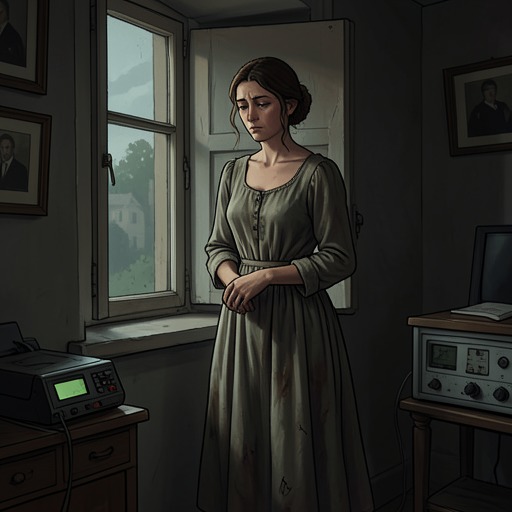
Anne's intervention in Janet and John's courtship
Anne of the IslandAnne Shirley’s intervention in Janet Sweet and John Douglas’s courtship turns advice into an immediate test of loyalty. After learning that John has spent twenty years visiting Janet without asking her to marry him, Anne urges her to take a stand. But when Janet follows that advice and John walks away, Anne cannot bear to let the separation stand: she runs after him, takes responsibility for the plan, and brings him back. The episode reveals the pain beneath Janet’s long patience and the conflict between Anne’s conviction that Janet deserves better and her recognition that Janet does not want to lose John.
Background: Twenty Years Without a Proposal
The conversation begins on Janet Sweet’s fortieth birthday, a date she meets with tears because John Douglas still has not asked her to marry him. Janet measures the delay not in abstract years but in the history of a courtship that has remained unresolved for two decades. John began visiting before her mother died; after a while, Janet started making quilts and other things, but he continued to come without speaking of marriage. To Anne Shirley, the length of the wait comes as new information: she asks whether John has really been coming to see Janet for twenty years, and Janet confirms that he has.
Janet explains why the pattern has endured. Her mother died after she and John had been seeing each other for eight years. Janet thought the loss might prompt him to speak, since she was then alone in the world. Instead, he remained kind and considerate, doing what he could for her, but still did not propose. His attentiveness and his silence have thus occupied the same relationship for years: Janet has received care, but no clear commitment.
The public explanation for the delay has deepened Janet’s embarrassment. People blame her, saying she will not marry John because his mother is often ill and Janet does not want the responsibility of caring for her. Janet says the opposite is true: she would gladly care for John’s mother. She has allowed others to believe the accusation rather than expose the more painful possibility that John simply will not ask. John’s mother, Janet adds, has repeatedly said she would like to see her son settled before her death and has encouraged him to marry. This removes one apparent obstacle without explaining his hesitation, leaving Janet distressed not only by the delay but by her inability to understand it.
Anne’s Advice and Janet’s Resolve
Anne first suggests that John’s mother may oppose his marrying, but Janet corrects her: his mother has urged him toward marriage, and Anne has heard her do so. Anne is therefore left without a clear explanation for John’s conduct. She presses Janet to show more self-respect and asks why she did not end the arrangement long ago. Janet answers that she has always been deeply fond of John and never wanted anyone else. Since his visits did not prevent her from choosing another partner, she saw little reason to send him away.
Anne argues that refusing to accept the arrangement might have forced John to state his intentions. Janet doubts this. She admits that she was afraid he would take her seriously and leave, and describes herself as lacking the spirit to risk that outcome. The exchange clarifies what Anne’s advice must confront: Janet’s patience is not simply passivity or indifference. It is bound up with affection and with the fear that demanding an answer could cost her the relationship she has valued, however uncertainly, for years.
Anne nevertheless insists that it is not too late for Janet to take a firm stand and promises to support her. Janet remains unsure that she can do it, but says she will think it over. Anne’s investment in the matter grows beyond general sympathy. She feels disappointed in John, whom she had liked and had not considered a man who would leave a woman’s feelings unsettled for so long. She concludes that he should be taught a lesson and anticipates satisfaction at seeing it happen. When Janet later tells her that she intends to show some spirit, Anne emphatically approves.
The Prayer-Meeting Reversal
The test comes after a prayer meeting, when John makes his usual request to accompany Janet. Janet looks frightened but resolute and refuses, saying she knows the road home alone after traveling it for forty years. Her formal address to him marks a deliberate change in their familiar routine: for once, she declines the escort rather than continuing to accept his regular attention without a declaration of marriage.
Anne watches John’s response. He turns without a word and strides down the road. The result is not the prompt explanation Anne hoped Janet’s firmness might produce, but an apparent departure. Anne immediately calls after him, disregarding the astonishment of the other people present. When he stops without returning, she runs down the road, catches his arm, and leads him back to Janet.
Anne presents the refusal as her own responsibility, telling John that it was all a mistake and that she had made Janet do it. She also appeals to Janet to confirm that everything is all right. Janet says nothing, but takes John’s arm and walks away with him. The scene does not disclose what John thinks or whether he has made any promise; its visible resolution is narrower. He does not continue down the road, and Janet chooses to leave with him.
Aftermath and Significance
Anne follows the pair home meekly and slips in through the back door. Janet then sarcastically challenges the reliability of Anne’s promised support. Anne replies that she could not help intervening: seeing John go, she felt as if she had stood by while a killing took place. Her comparison describes the force of her reaction, not a literal danger. She had encouraged Janet to risk losing John in order to make him act, but when that possibility appeared real, Anne could not maintain the advice from a distance.
Janet is not simply angry at Anne’s reversal. She admits that she is glad Anne brought John back. As he walked away, Janet felt that the remaining joy and happiness in her life were going with him. That admission makes the scene’s reversal more than a comic correction of Anne’s overconfidence: the refusal has made Janet confront the emotional cost of the boundary she tried to set. Her attachment persists even while the uncertainty that prompted her distress remains unresolved. When Anne asks whether John questioned her about the refusal, Janet says that he did not speak of it. The episode therefore ends with physical closeness restored but the central question still unanswered. Anne’s intervention exposes the gap between insisting that Janet deserves a decision and knowing how much she fears the consequences of demanding one.